
EV Battery Related Detailed Introduction
1. Industry and assembly characteristics: why battery manufacturing relies heavily on “tightening + feeding”
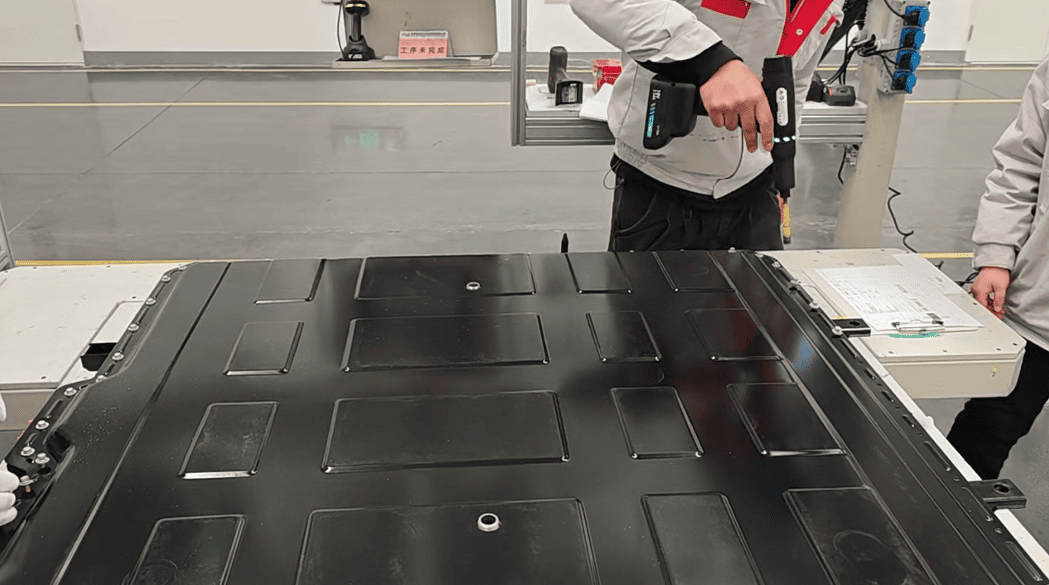
New energy battery-related products (such as battery systems)
represent critical high-end assembly scenarios, typically featuring
dense fastening points, demanding takt time requirements, and
stringent expectations for consistent quality.
Leetx solutions are widely applied in high-end manufacturing sectors
including NEV three-electric systems. Built on a unified technology
platform, Leetx products support fast iteration and deep
customization, enabling richer product choices and more agile
process response for advanced assembly.
In battery manufacturing and battery system assembly, bolts and
screws are widely used for structural fixation, housing/cover
assembly, brackets, and accessory installation. Any missing
fastener, wrong fastener, or nonconforming tightening result may
lead to rework and quality risk.
As a result, manufacturers typically focus on:
Stable takt time: Reducing non-value-added manual actions
such as searching, picking, and aligning fasteners, and shifting
takt-time variability from operators to the system.
Consistent quality: Delivering stable and controllable
tightening results throughout long-run mass production, minimizing
human-induced variation.
Process traceability: Ensuring that process records for
critical joints can be retained and analyzed for quality audits and
closed-loop problem solving.
Leetx builds assembly units around tightening systems and automatic screw feeding systems and supports an approach that links assembly data acquisition, quality traceability and process optimization well aligned with the strong requirements for mass production consistency and traceability in the battery industry.
2. Typical stations and how Leetx is applied (tightening + feeding synergy)
A. Battery system structural joints: housings / covers / frames with multiple fastening points (tightening-centric)
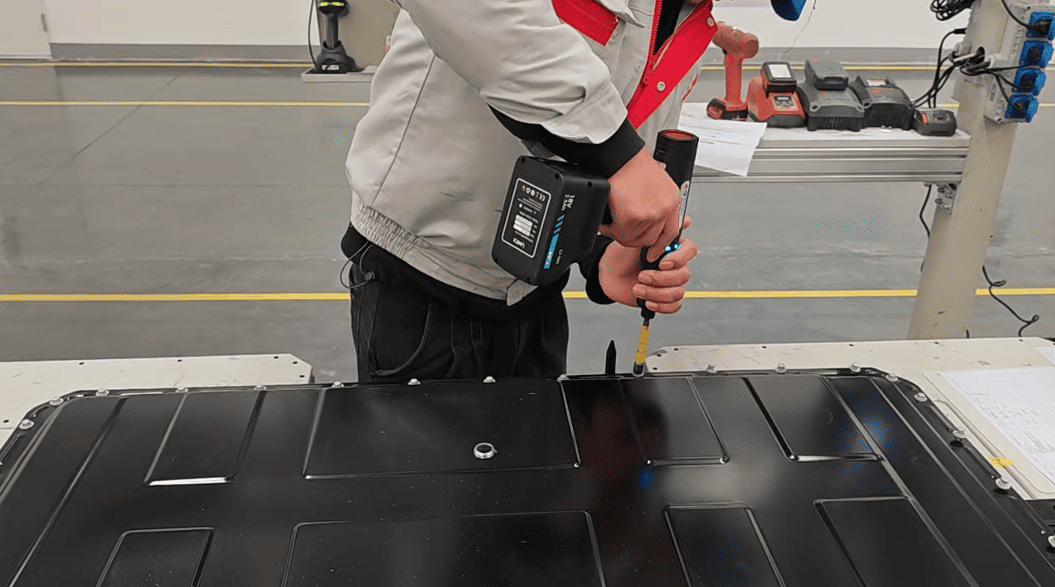
These stations commonly involve multiple bolts/screws per unit,
repetitive cycles, and high consistency requirements—typical
applications for tightening systems.
How Leetx is applied (tightening first):
Manual, semi-automatic, and fully automatic tightening
solutions:
Matching the customer’s automation level and rollout strategy,
supporting phased deployment from pilot builds to mass production.
Station-level modular delivery concept:
A production-ready tightening station can be structured around the
tightening controller and tightening tool, with necessary station
accessories to support stable operation in mass production.
Multi-point coordination (optional):
Where simultaneous multi-point tightening or higher consistency is
required, multi-spindle or synchronized concepts can be adopted to
improve efficiency and reduce operator-driven variability.
B. High-frequency small screw stations: brackets, covers, accessories and fixation points (feeding impact is highest)
Battery system assembly and peripheral stations often feature
low-torque, high-frequency fastening with multiple screw variants.
Manual handling consumes takt time and increases the risk of wrong
screws, missing fasteners, and mixed parts.
How Leetx is applied (feeding + tightening integration):
Automatic screw feeding to reduce non-value-added work:
Systematizing screw delivery and presentation reduces dependence on
operator skill, stabilizes takt time, and lowers the risk of
missing/wrong fasteners.
Modular tightening and pick-up concepts for different fixtures
and space constraints:
Module options can include vacuum-type tightening modules, Pick & Place tightening modules, and quick-change Pick & Place modules to adapt to posture, space, and tooling conditions.
Configurable feeding mechanisms and accessories to stabilize
feeding:
Solutions may combine bowl feeders, step feeders, and hoppers, along with accessories such as distribution, cleaning, screw presentation, and screw brakes to improve feeding stability and takt performance. Final selection is recommended to be validated through feedability analysis based on screw characteristics and tooling constraints.
